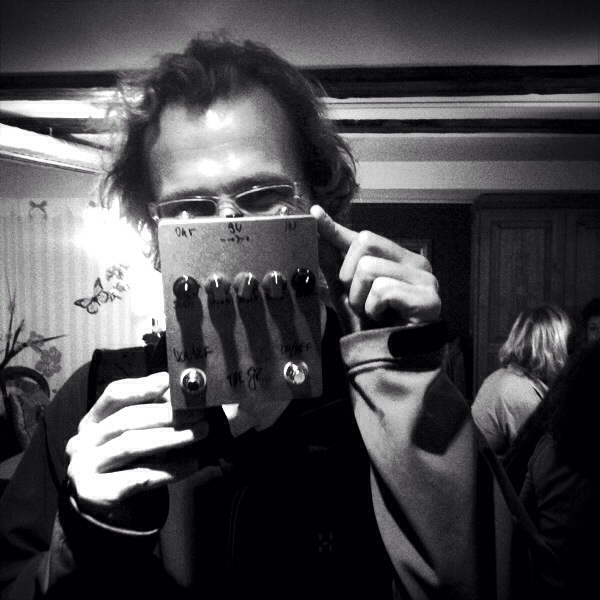
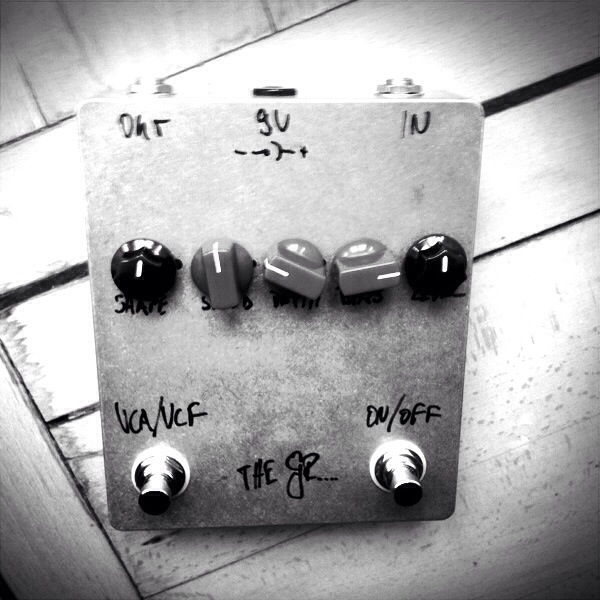
Arne makes effect boxes on his own. Sometimes he rebuilds, sometimes he creates something new. He came to my café and left this box. What can this be? Got to find it out during the next days…
Meanwhile listen to Arne’s quiet track from “How to catch STILLE?”
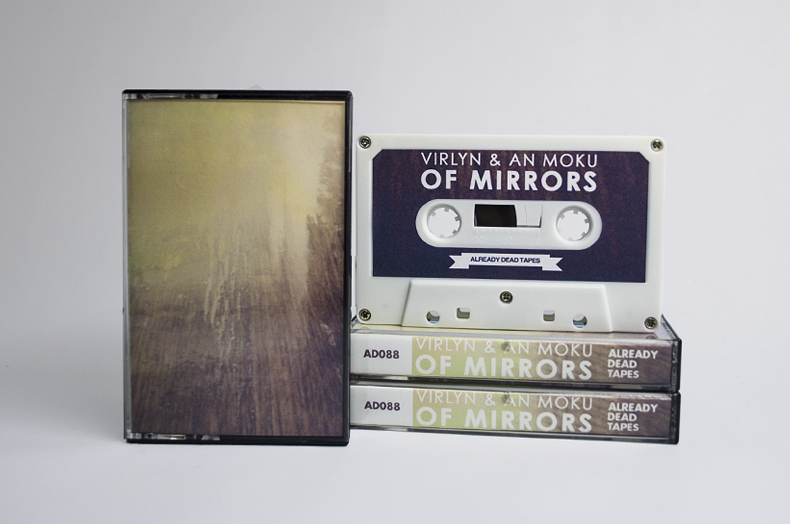
“Virlyn and An Moku’s release, ‘Of Mirrors’ has an organic element. Meaning there is a naturalness to the ‘putting together’ of each song. The album is for explorers, while the sounds settle in being extremely meditative, surreal, and ambient. They take old classical instruments and use them as acoustic drones while acquiring and manipulating specific elements of the sounds for each song. Both musicians have an outstanding history from creating theatrical performances of Herman Hesse novels to being part of supporting acts for Whitney Houston, Joe Cocker and several others.
The phrase ‘Nature is beautiful’ is a purveying interpretation for the listener here. As they hear slow waves, and other ‘found’ sound samples, played alongside the dirgeful drones and scattered bits of solemn strings, “Of Mirrors” brings out the beauty in a natural progression. Virlyn and An Moku create the perfect ambience for multiple types of backgrounds by incorporating recordings from the lobbies before a jazz concert, reproducing the sounds of hiking through the woods, and waves rushing and crashing – all tied up with a classical harmony and steady drones. Coming from two countries, Belgium and Switzerland, it’s Virlyn and An Moku’s collaboration, ‘Of Mirrors.’” Ray Jackson, Already Dead Tapes, 2013
Of Mirrors:
Steelyard blues
Secret place
Dance of the creatures
Mirror (Part1)
The room
Frost
Digital bonus track: Mirror (Part2)
Total running time: ca. 60 min
All music composed and produced by Virlyn and AN MOKU
Mixing and mastering by Virlyn
Electronics by Virlyn
Electronics, instrumental and field recordings by AN MOKU
All instrumental and field recordings captured in Switzerland and Iceland
Ending of ‘Frost’ captured during an orchestral warm up session at Harpa, Reykjavik
Swiss Performers:
Piano by Cornellia Stromeyer
Violin by Orina Zänerle
Cello by Jacki Knöpfel
Modified vocal sample taken from -The Seventh Seal- by Bergman, 1957
Photography:
Dominik Grenzler
Design:
Pan Pan/Joshua Tabbia
‘Of Mirrors’ has been recorded from november 2011 until march 2012.
After finishing it, we kept this album in our secret place until today.
Thank you for supporting us. Enjoy the tape!
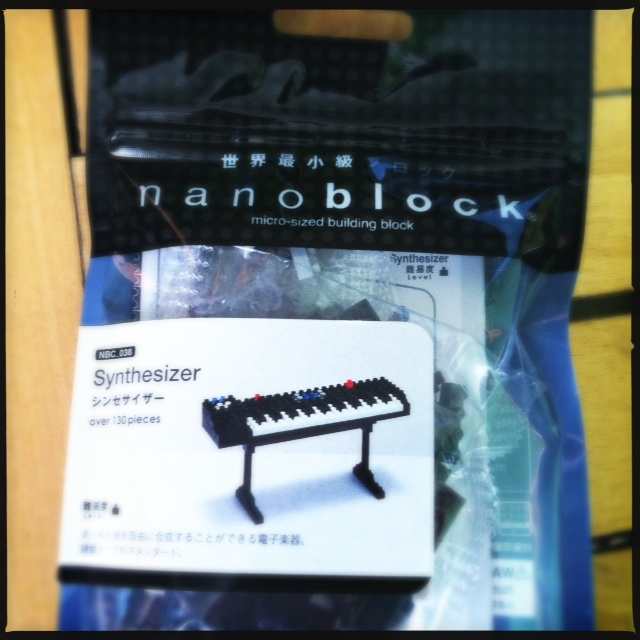
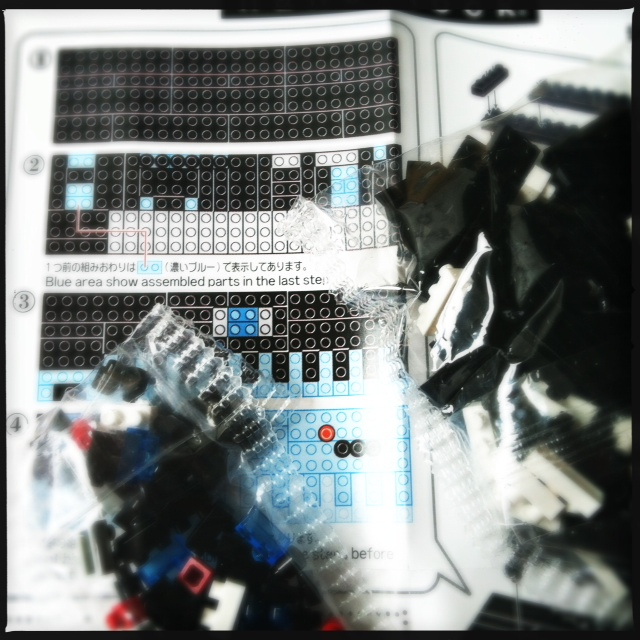
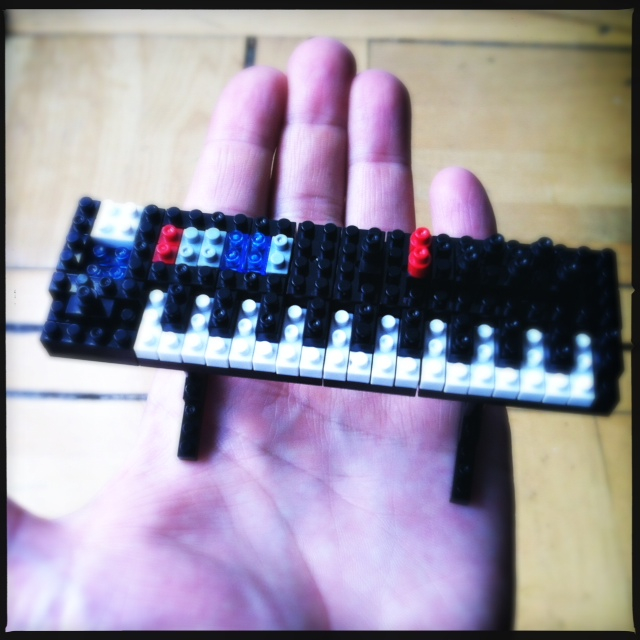
The guys from Nanoblock created an over 130 piece toy synthesizer. «Easy!» – That’s what I thought and it took me more than one hour to built it finally by misunderstanding the plan. The final product? A little bit different kind of the origin toy synthesizer. Pity, you cannot play it ;-)
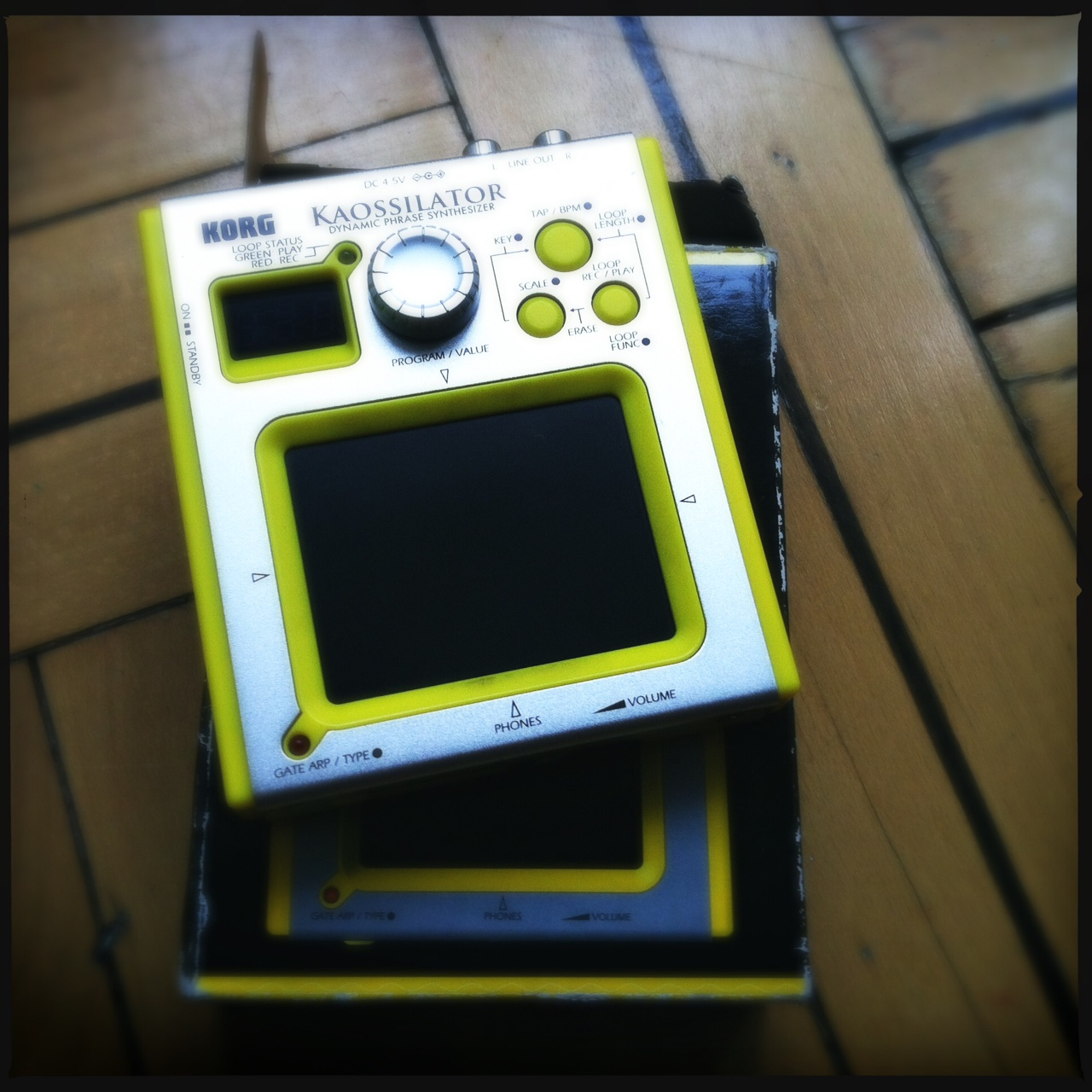
Seit 2008 besitze ich einen Kaossilator, den ich damals in Tokyo gebraucht gekauft habe. Um ganz ehrlich zu sein, ich habe paar Aufnahmen damit gemacht, die ich auch verwendete, aber mich nie ernsthaft damit beschäftigt. Mittlerweile gibt es diverse Nachfolger, Pro, Pro+ und iKaossilator.
Hier ein kleiner Überblick:
The Korg Kaossilator KO-1 is a portable dynamic-phrase synthesizer manufactured by Korg. It is capable of producing a wide range of sounds, can produce a continuous music loop, and can be tuned to various keys and scales.
Being related to the Korg Kaoss Pads, the Kaossilator is a synth that is played touching a pad that is not unlike a trackpad on laptop computers. For most sounds, moving horizontally on the touchpad changes the pitch over a range of two octaves (in one case, only one octave; for several sounds the range is much more than two octaves). For some sounds, horizontal movement affects a non-pitch parameter. Moving vertically usually modulates the sound in some way.
The Kaossilator features 100 programs, which are mostly synthesizer voices and sound effects, including acoustic (guitar, trumpet,piano), percussion, and electronic sounds. The last 10 programs are complete rhythm-patterns, but since percussion sounds are included in the programs, users can develop their own rhythm-patterns by layering multiple overdubbed sounds. Programs are indicated only by a letter-and-two-digit designation on the LED display but are given specific names in the instructions. Most instruments can be locked into various keys and scales. The Kaossilator supports 31 different scale patterns including chromatic, blues and diatonic scales as well as more exotic scales such as Japanese and Egyptian.
The Kaossilator also has a gate arpeggiator and a loop function that allows the layering of instruments to produce loops. The loop recording function is somewhat limited, as the maximum length is two bars in 4/4 time. Despite this limitation, some artists have recorded full-length albums with the Kaossilator.
It is possible to overcome the two-bar limit as the Kaossilator records audio to memory. To do this the user sets the tempo to the desired value – 150 for example – and records his part. The tempo is then set to exactly half the tempo of before, in this case 75. When played back one hears the first two bars but then two more will be available afterwards.
Another way to fully overcome the two-bar limit is by powering up the Kaossilator while holding down the Tap and Loop Rec buttons. Doing this will make four bars available (by setting the Loop Length to 16), but this disables the Undo function.
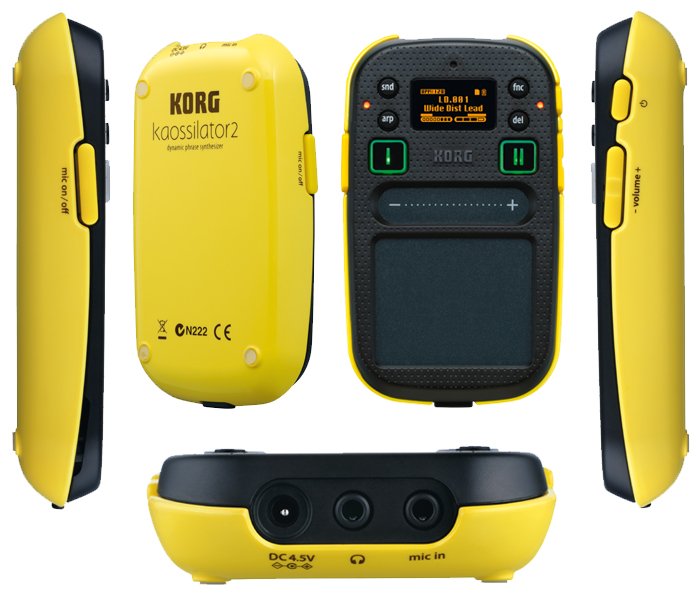
An updated Kaossilator KO-2 was unveiled at the 2012 NAMM show, with 150 programs, two sound-banks, a save for audio files on a micro-SD card, built-in microphone and speaker, and touch-slide with + and – step buttons instead of a knob. The Kaossilator 2 was released in April 2012 at a retail price of US$160.
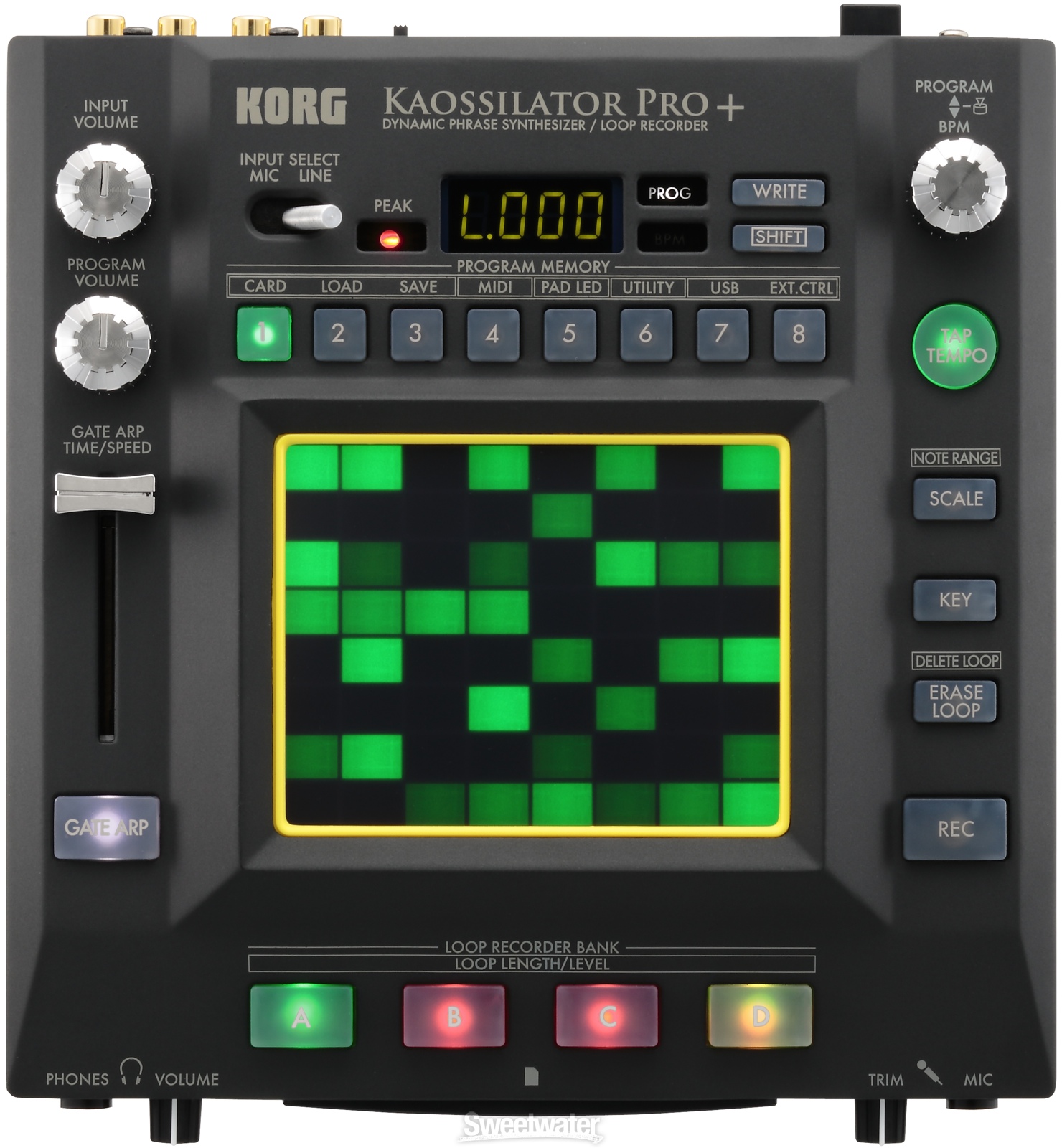
Korg unveiled the Kaossilator Pro at NAMM on 14 January 2010. The device has a metal casing similar to the Kaoss Pad 3 (KP3), but its touchpad (divided into an 8×8 grid of rectangles) is back-lit with green lights instead of the KP3’s red lights.
The larger pad makes it easier to hit specific notes compared to the original Kaossilator. It offers 200 sounds, vocoder patches, four channels of looping, MIDI, a gate arpeggiator, 31 scales, editor software, and other features. Unlike the original Kaossilator, it allows music-loops and settings to be saved on an SD memory card.
The Kaossilator Pro+ Version has even 250 sounds. The whole system has been unpated. Bigger and better.
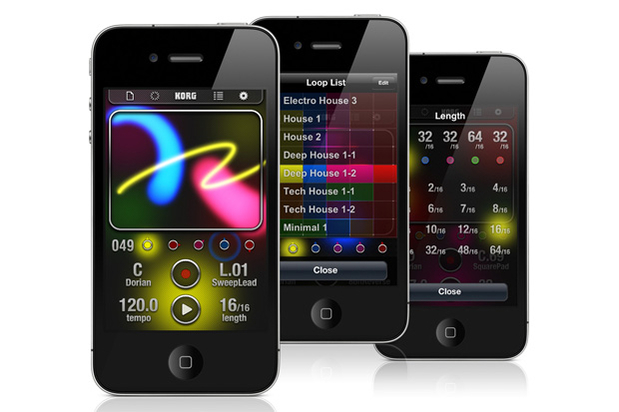
A software-only version is available as an application for Apple’s iPhone and iPad. The iKaossilator offers 150 sounds, a 5-track loop sequencer, scale/key settings, WIST support and the ability to save/resume an ongoing project but does not have an arpeggiator.
Hell yeah! But what is this little white thing that looks like Korg’s nanoKey from a distance?
Let’s take a closer look…
The first time that I have realized an OP-1 portable synthesizer was in the studio live performance of Depeche Mode’s «Broken». To be honest at that time I thought that DM is performing a plugin with a nanoKEY. But it was not so. Some days ago I have made a post about Meme Antenna from Brooklyn and their customized modular systems. They had a plastic synthesizer with little plastic knobs and other additional plastic gadgets to buy there as well. Back in the hotel I had to find out more about that toy synthesizer and found a lot which impressed me!
This is DM’s studio live performance. If you do not like the track, just skip to 0:33 and 0:39 to see the OP-1 in action.
I went to the homepage of Teenage Engineering and got impressed by that video:
The accessory demonstration is great! If you like to play with Lego or even go for DIY instruments, you like it. Further on a full review by Sonicstate:
«Do you need it? I do not know. Do you want it? Hell yeah, I’d love one!»




 An Moku